








Mold in air ducts in Baton Rouge, LA

Find a duct system pro

Baton Rouge summers are long and muggy, and that moisture has to go somewhere. If it's settling in your ductwork, you're probably noticing it before you can see it, a musty smell when the air kicks on, maybe more dust than usual, maybe someone in the house sneezing more than they used to. You searched this because something told you to check your ducts, and that instinct is worth acting on. Mold doesn't stay put once it has a foothold in a system that's running most of the year. What you need isn't a lecture on how mold grows. It's someone who can get into your ducts, see what's actually there, and tell you what it takes to deal with it. That's what this page connects you to. Fill out the form and you'll be matched with a contractor who handles duct cleaning in your area, and they'll reach out to you directly. No more searching, no more guessing who to call.

Can mold actually grow inside air ducts?

You keep the air conditioner running most of the summer, and lately the air coming out smells musty. Someone mentioned mold in the ductwork, and it sounds like something that would only happen in a neglected system, not yours. You want to know if that's actually possible, or if it's something else.

Yes, if there's moisture in the ducts, mold can grow there

Mold needs moisture and something to feed on, and ductwork can supply both. When humid air moves through a duct that's cooler than the air around it, like the supply ducts carrying cold air from your AC, moisture condenses on the inside walls. Dust sitting in the duct gives mold something to grow on once that moisture is there. In Baton Rouge, the air conditioner runs for months at a stretch, which means those ducts stay damp on the inside for months at a stretch too. A musty smell when the air kicks on is often the first sign, before anyone sees anything. Mold doesn't need standing water to take hold. It just needs the duct to stay wet longer than it dries out, which is exactly what happens when cooling runs nearly nonstop.

Galvanized sheet metal HVAC ductwork and round pipes running along an exposed wood-joist basement ceiling beside a plain white wall.

Why ducts hold onto moisture

Air conditioning pulls humidity out of the air and that moisture collects on the evaporator coil, then drips into a condensate pan and drain line. If the system runs for hours at a stretch, which it does most days from April through October here, the ducts nearby stay damp longer than they ever dry out. Mold needs that dampness plus something to feed on, and the dust sitting in a duct is enough. A closed-up house with the air conditioner cycling all summer gives it both.

Galvanized sheet metal HVAC ducts and round pipes installed among wooden joists on a ceiling, beside a large blank white wall.

What a cleaning actually removes

A duct cleaning clears the dust, debris and any mold growth from the inside surfaces of the supply and return lines, using negative pressure to pull material out rather than push it further into the system. It does not change the humidity in the house or fix a drain line that is backing up. If the moisture problem behind the mold is still there after the ducts are clean, mold can return, which is why the cause matters as much as the cleanup.

Why does mold keep coming back in Baton Rouge ductwork?

  • Half the homes here were built by 1984

    Cooling runs April through October here, seven months of the coil staying wet and the duct system never getting a long stretch to dry out.

  • Heat runs November through March

    Heat only runs November through March, and even then it's mild, so the system spends most of the year in cooling mode, where moisture collects.

  • Cooling runs April through October

    Half the homes in the parish were built in 1984 or earlier. If your ductwork came with the house, it has run through decades of humid summers.

ACS 2020-2024 · NOAA nClimDiv 1991-2020

A musty smell and a dusty vent might just mean the filter's overdue, and swapping it out clears things up in a day. That's worth trying first since it costs nothing but five minutes.

If the smell comes back within a week or two, a new filter never was the problem. Something inside the ducts is staying wet long enough to grow, and that calls for someone to look at the system itself.

A woman in a cream cowl-neck sweater stands in a lamp-lit room looking out a window at a snow-covered yard with shrubs and bare trees at dusk.
A woman in a gray turtleneck sweater stands near a large window in a lamp-lit living room, looking out at falling snow and snow-covered conifers.
A woman in a chunky knit sweater stands by a large window looking out at snow-covered ground, with a dimly lit living room containing a gray sofa, framed artwork, shelves and table lamps behind her.
A woman in a gray turtleneck sweater stands in a dimly lit living room with a lamp and bookshelves, looking out a multi-pane window at falling snow.

Get matched with a duct system pro in East Baton Rouge Parish

You've tried the filter, and the smell came back. At that point it isn't dust sitting on a pad, it's moisture living somewhere in the duct run itself, on the coil, in the drain pan, along the sheet metal. Seven months of the year that system stays damp from the inside, and a filter change was never going to reach past the plenum. Someone has to get into the ducts themselves, see where the moisture is sitting and clean it out, and know what to check on the drain line so it doesn't just come back in a month. That's a different job than the one you already tried, and it isn't one to guess your way through, because what looks like the same musty smell can be a light coating on the coil or something further down the run that's been building all summer. Get a contractor who works on Baton Rouge duct systems to take a look before another humid stretch gives it more time to spread.

What mold in your ducts means day to day

Once mold is established in the duct run, it rides the air the system pushes into every room. You'd notice it first as a smell that's strongest right when the AC kicks on, then fades, because the air moving past the growth is what carries it. Some households notice someone starts coughing more at home than away from it, or a sinus problem that eases up on vacation and comes back within a day of returning. None of that proves mold by itself. But if the musty smell is there and a family member's symptoms track with time spent in the house, that's worth paying attention to, not writing off as allergies in general.

What keeps it coming back

A duct system that's grown mold once has the conditions to grow it again, because the moisture source didn't go anywhere. The coil still sweats every time the compressor runs, the drain line still needs to carry that water out, and Baton Rouge summers still mean the system runs for hours most days from April through October. Cleaning the ducts removes what's already there. It doesn't change how wet the coil gets or how often the system cycles. Without something addressing the moisture itself, a duct system here can end up needing that cleaning again, sometimes within the same year it was last done.

A bearded man in a plaid flannel shirt stands indoors looking out a condensation-covered window at a snowy landscape, with a speckled mug on the sill and kitchen shelves behind him.
A bearded man in a dark t-shirt sits on a light sofa, smiling and looking down toward a laptop screen visible at the bottom edge of the frame, with a blurred living space behind him.

How mold actually takes hold

  • Mold needs three things to grow: moisture, a food source, and still air, and a duct run sitting damp for months supplies all three.
  • The sheet metal or flex duct itself does not feed mold, but the dust and skin cells that collect on its surface do.
  • Mold spores are already in the air of every home, so the duct does not need to be contaminated from outside to start growing it.
  • A duct system has no light and almost no airflow variation once the blower cycles off, which is exactly the setting mold needs to establish.
  • Flex duct with an inner liner holds moisture differently than rigid metal duct, and once the liner is colonized it is harder to clean than sheet metal.
  • Mold growing near the evaporator coil can spread downstream through the supply run long before it reaches a point where you can see or reach it.

Mold does not need anything unusual to grow in a duct. It needs moisture, something to feed on, and air that is not moving much, and a duct system left damp for months at a time gives it all three without any help. The metal or flex duct itself is not the food. What feeds it is the dust and skin cells that settle on the inside surface, the same material that collects on any surface in a house. The spores are already there too, floating in the air of every home, so nothing has to get in from outside to start a colony. Once the blower shuts off, the duct sits dark and still until the next cycle, and that stillness is exactly the condition mold needs to establish itself rather than just pass through. Rigid metal duct and flex duct do not behave the same way once that happens. Flex duct has an inner liner, and moisture sits against that liner differently than it does against sheet metal, which makes a colonized liner harder to clean out once mold has a hold on it. The coil is usually where it starts, since that is where the moisture is heaviest, but it does not stay there. Mold can spread down the supply run well before it reaches anywhere you could see it or reach it by hand.

Power here costs 12.50 cents per kilowatt-hour

Running the air conditioner here doesn't cost much, so most homeowners just let it run all day rather than cycle it to save money. That keeps the coil wet and the duct run damp for months at a stretch, which is exactly what mold needs.

EIA-861 2025

Empty concrete-walled basement room with bare floor and an exposed wood-joist ceiling carrying galvanized rectangular and round sheet-metal ducts, black pipes, and wiring.

Ductwork that's keeping up

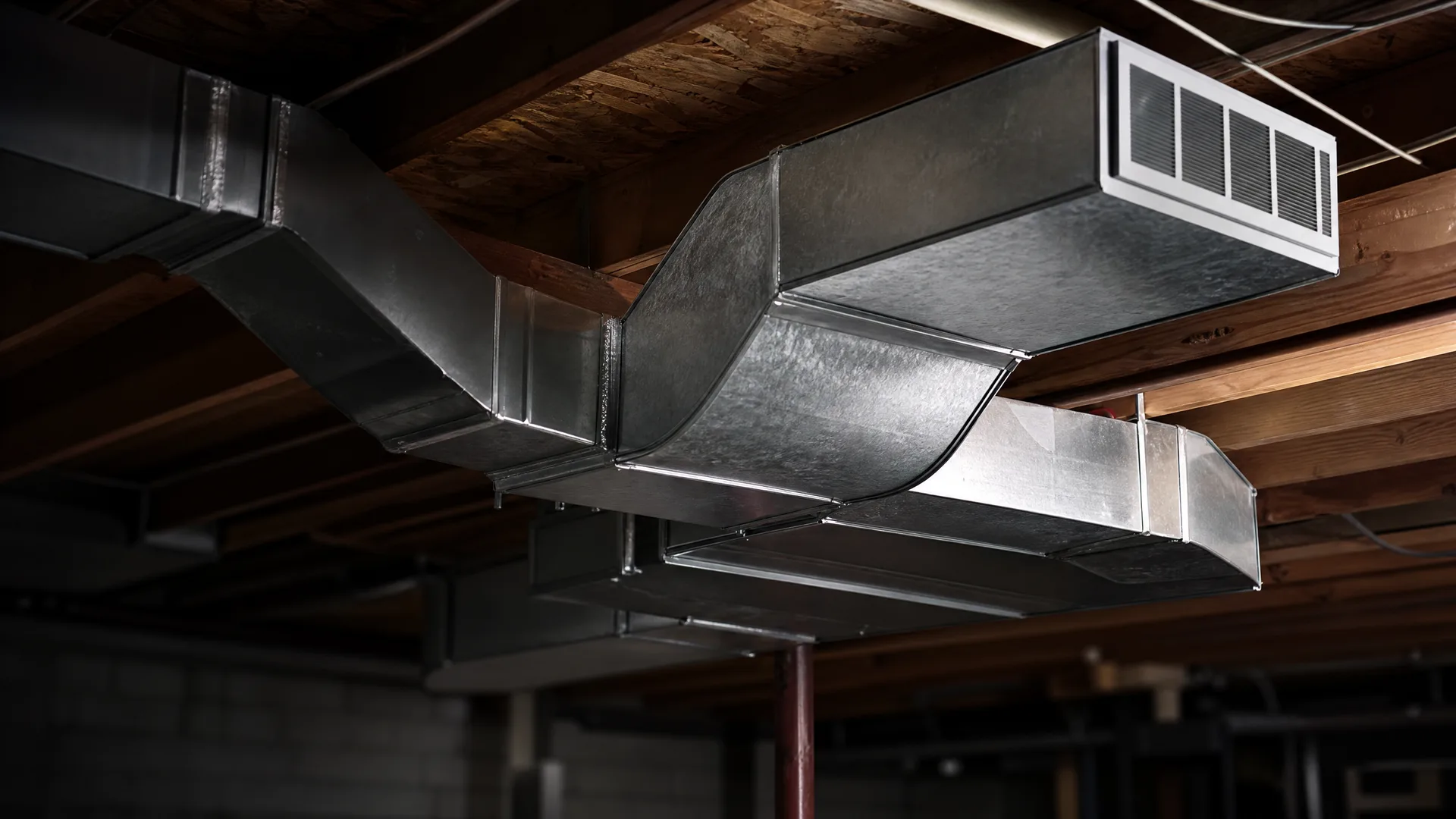
The metal is bright and the seams are tight, round branch lines and rectangular trunk lines both holding their shape. Air moves through clean, dry metal with nowhere for moisture to sit. This is what a duct run looks like before seven summers of standing damp catch up with it.
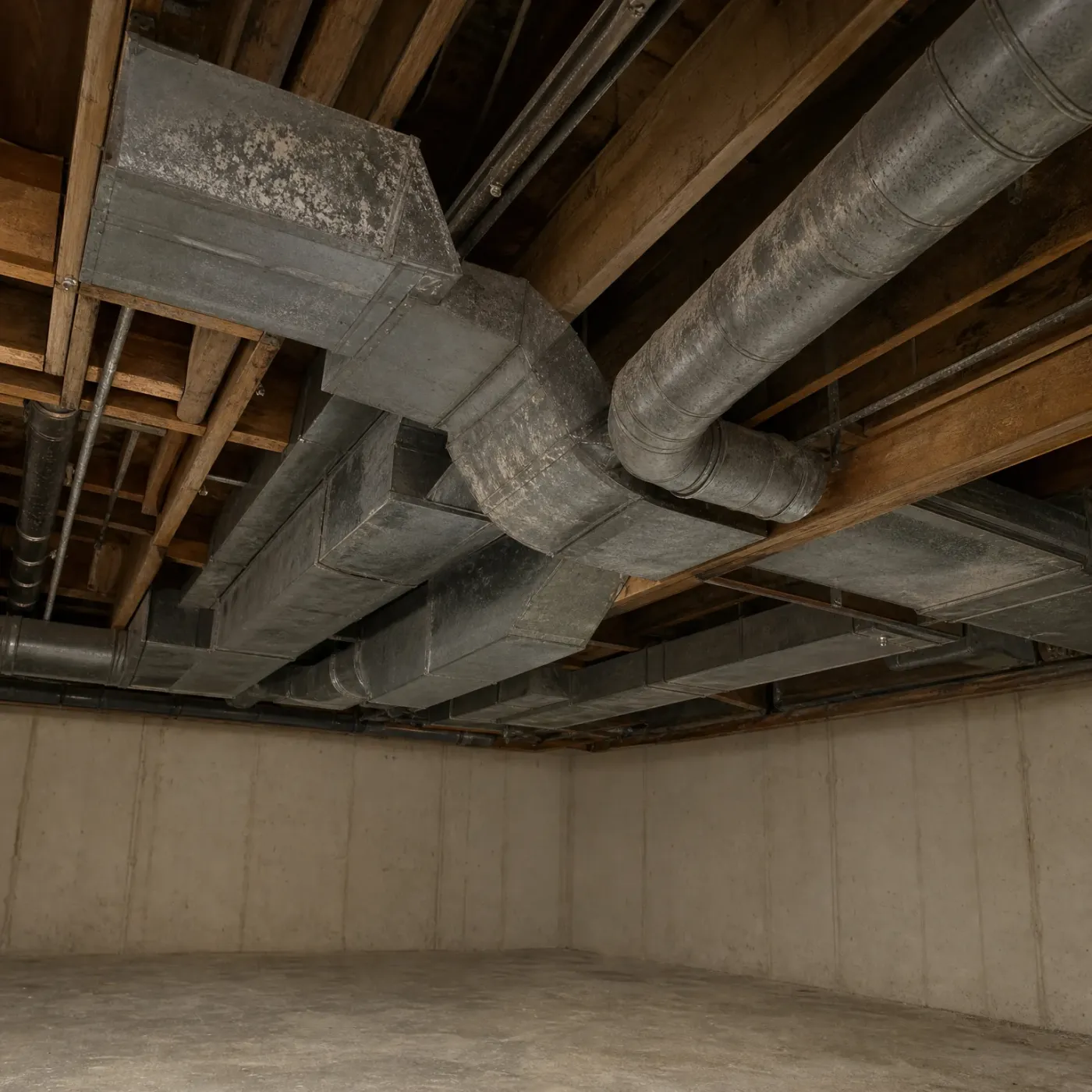

Empty concrete-walled basement room with exposed wooden joists and galvanized rectangular and round ductwork plus pipes running across the ceiling.

Ductwork losing the fight

The sheet metal has gone dull and spotted, oxidation spreading across the trunk line and the pipes running off it. Duct runs that stay damp this long usually have more going on than surface rust. If the smell comes back after a filter change, this is often what's behind it.

A woman in a long cream cardigan and jeans stands at an open wooden front door of a gray shingled house with stone-based porch columns, with a second person visible inside, and potted flowers and shrubs beside the entry.

Where that leaves you

A musty smell that comes back after a new filter means mold somewhere in the duct run, not dust on a pad. In a parish where the AC runs April through October and the coil stays wet most of that time, that's not rare and it's not a sign anyone did something wrong. It's what this climate does to a duct system that never gets a long stretch to dry out.

Fixing it means someone getting into the ducts, the coil, and the drain pan to find where the moisture is sitting and clear it out, not just covering the smell. A local contractor who works on Baton Rouge systems all summer has seen this exact setup before. Send the form and that part stops being something you have to figure out on your own.

A light-colored ceramic vase holding green leafy branches sits on a round wooden table, with a wooden-framed armchair draped in a cream throw, a tripod floor lamp, and sheer curtains blurred in the background.
Galvanized sheet metal HVAC ductwork with a white vent grille, mounted against wooden floor joists in a dim basement with concrete block walls.

Find a duct system cleaning pro in East Baton Rouge Parish

Duct and vent cleaningDucts or ventsEast Baton Rouge Parish, LA
Step 1 of 2

What ZIP code is the job in?